
One January, an ice storm put our part of East Tennessee in the dark for nine days. I was still working as a lineman then, and I spent most of that week in a bucket truck while my own house sat cold. When I finally got home, Carol had the fireplace going and a camp stove on the porch, and we managed fine. But I remember standing in the kitchen that second night, eating soup by flashlight, thinking about all the people who had not prepared for it at all.
That storm is the reason there is a Ready America 70280 two-person kit hanging by our back door today. I bought it as a starting point, not as the finished answer. A pre-packed kit gets you most of the way there, but a go bag that works for your family is one you have gone through yourself, added to, and tested. This is how I turned that kit into a 72-hour go bag that fits Carol and me, our medications, and our corner of Tennessee.
Start With the Kit, Then Make It Yours
The Ready America 70280 is the same kit I built my go bag around. It gives you food, water, light, a radio, and a first aid kit in one backpack, with room left over for everything your family adds.
Amazon Check Today's Price on Amazon →What the Ready America 70280 Gives You Before You Touch It
The Ready America 70280 comes as a full backpack, not a box of loose gear. Inside mine were food bars for two people for three days, sealed water pouches, a hand-crank flashlight and radio with a phone charger, two ponchos, an emergency blanket, a basic first aid kit, dust masks, work gloves, a whistle, and a few smaller items like moist towelettes and a light stick. The backpack itself is the carrying case, which matters more than people think. A kit in a cardboard box is a kit you have to find another bag for.
Right away, two things stood out. First, the food and water are survival minimums, not comfort. They will keep two people alive for three days, and that is exactly what they are for. Second, the kit is generic on purpose. It does not know about Carol's blood pressure medicine, or my reading glasses, or the fact that we live up a holler where the nearest pharmacy is twenty minutes away. That is not a flaw in the kit. It is the part you are supposed to finish yourself.
Step 1: Empty the Bag and Inventory Everything
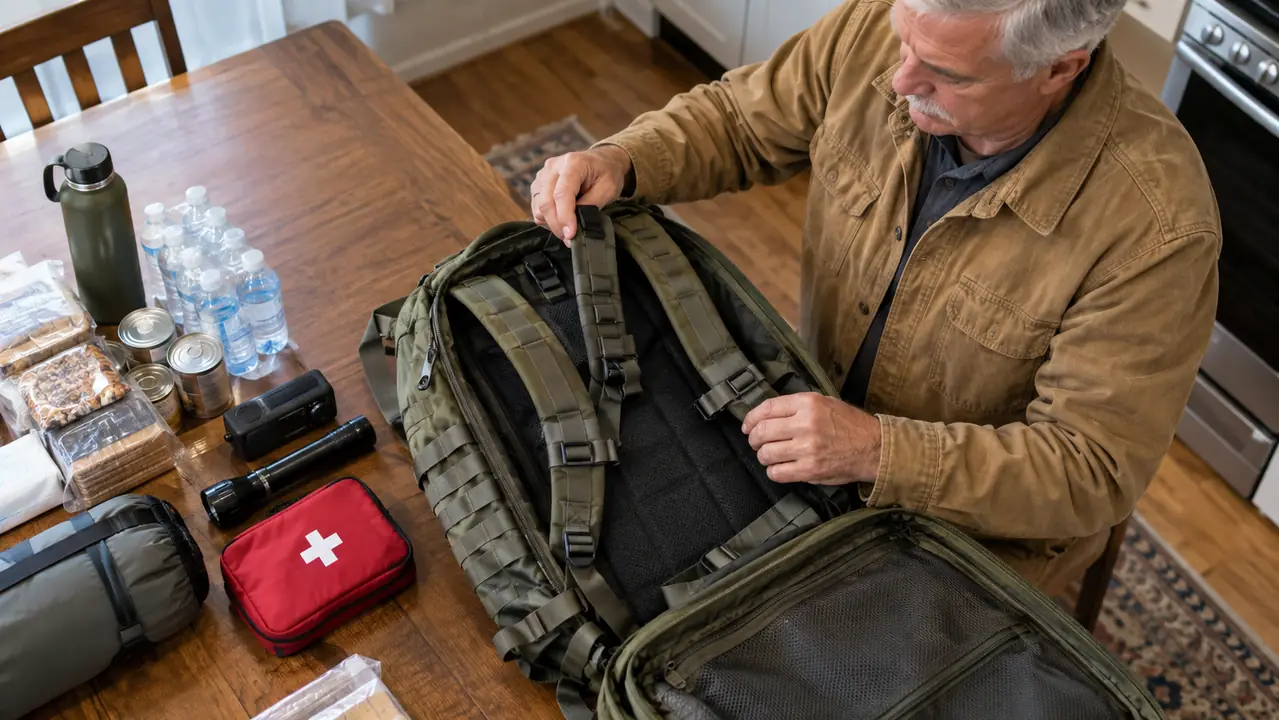
I did this on a Sunday afternoon in January, the same month as the storm that started all of this. Carol and I spread the kit across the kitchen table and laid every item out in rows. I wrote each thing down on a yellow legal pad, the same kind I used for years as a lineman. It sounds like busywork, but it is the single most important step in this whole process. You cannot plan around gear you have never looked at.
Check the dates on the food and water first. The sealed pouches and food bars have a shelf life, and some kits sit in warehouses for a while. Mine were well within date, but I wrote the replacement dates on the outside of the bag with a permanent marker so I would not have to dig for them later. I also went through the first aid kit item by item. The one in mine had the basics, bandages, antiseptic wipes, gauze, and tape, but I added a tube of antibiotic ointment and a small bottle of ibuprofen. Those two things have solved more problems in my life than anything else in a first aid kit.
When the list was done, I had a clear picture of what the kit covered: food, water, light, weather protection, and basic first aid. What it did not cover was the stuff that is specific to us. That is exactly what the next four steps are for.
Step 2: Add Medications, Documents, and Personal Needs
This is the step where a go bag becomes yours. Carol takes a blood pressure medication every morning, and I carry a couple of prescriptions for my back from the years I spent climbing poles. We each put seven days of our medicines into the bag, not just three. I used a small plastic organizer with the days of the week printed on it, the kind you can buy at any drugstore, and I wrote the dose on a strip of tape in case one of us is too rattled to think straight during an emergency.
I also added a folder with photocopies of our driver's licenses, our insurance cards, and a list of phone numbers written on paper. Not in a phone, on paper. The last thing you want in an emergency is to realize your only copy of every important number is in a dead phone in your pocket. Card readers do not work without power either, so there is a small amount of cash in small bills tucked into that same folder.
Think about the people who would use this bag with you. If you have kids at home, add a change of clothes for each child, a small toy or book, and anything they need at night. If you wear glasses, put a spare pair in the bag. If you have a baby, the diapers and formula go in before the granola bars. The kit is a frame. You are the one who fills in the picture.
Step 3: Rethink the Water and Food
Here is the honest math on water. A person needs about a gallon a day in normal conditions, more in summer. The pouches in the kit are a start, but they are not a three-day supply for two people. I added a one-liter filter bottle to the side pocket of the bag. We have creeks all over this part of Tennessee, and a filter bottle turns a creek into drinking water without having to boil it. I also added a small pack of purification tablets as a backup, because backups are what emergency gear is made of.
The food bars in the kit will keep you alive, and I tested them on an overnight trip so I know what that feels like. They are dense and dry, and they go down easier if you take small bites and drink water with them. But after that trip I added food we would actually want to eat: peanut butter packets, granola bars, a few cans of soup with pop tops, and a bag of trail mix. Nothing that needs cooking, nothing that needs a can opener, and nothing that will go bad in the heat of a car trunk.
Mark a date on the calendar to rotate this food. I use the same weekends I change the clocks, twice a year. When the time changes, I pull the food and water out of the bag, replace anything getting close to its date, and put the older stuff in the pantry where we will eat it in the normal course of a week. That way nothing in the bag ever goes to waste and nothing ever gets stale.
Step 4: Make the Bag Something You Can Actually Carry
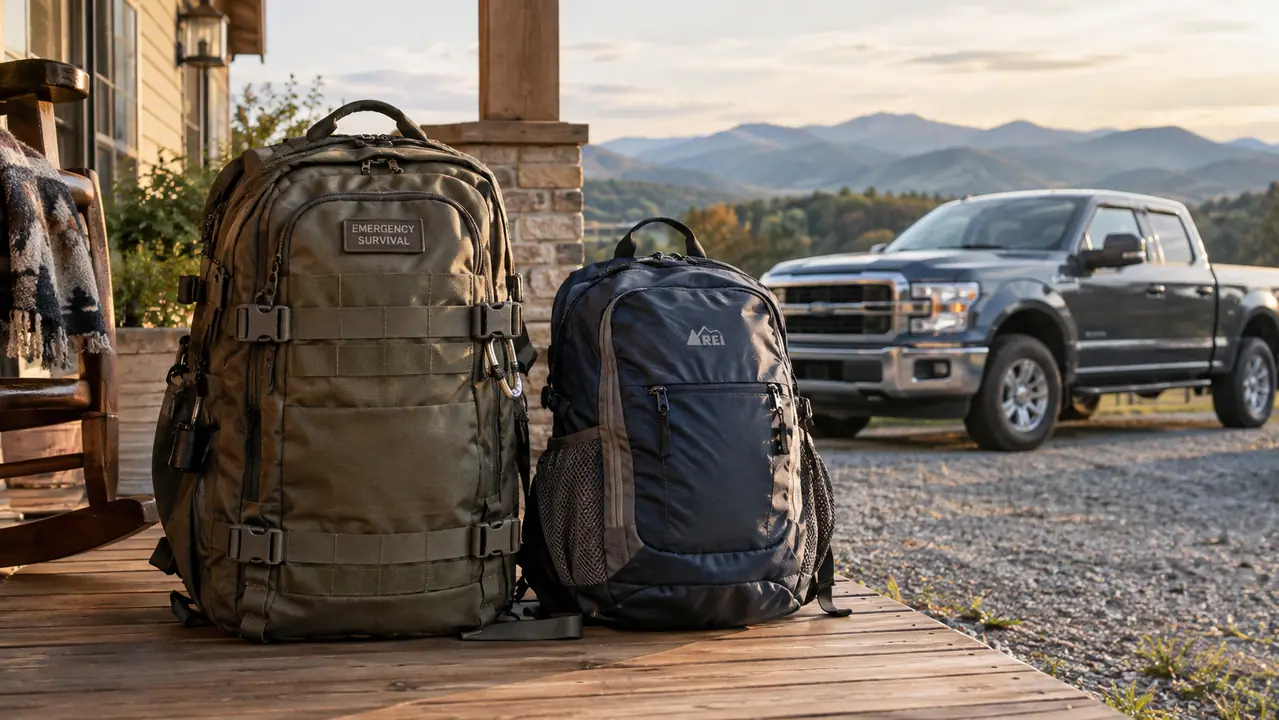
A 72-hour kit for two people is not light. When I put ours on the bathroom scale, it came in at about eighteen pounds before I added the water and the heavier food. That is a manageable weight for one adult, but it is too much to ask of a smaller person in a stressful situation. So I split the load. The Ready America backpack stays by the back door as the main bag, and Carol has a small daypack I picked up at a thrift store. It carries her medicines, a change of clothes, and a paperback. She can grab it with one hand.
Take the time to adjust the shoulder straps before you need the bag. I see people hang a kit on a hook and never put it on until the day they evacuate, and that is the worst possible time to learn the straps are too loose or the bag rides wrong. Put the bag on, tighten the straps so it sits high on your back, and walk around the house for five minutes. Adjust it until it feels right. Do the same for anyone else who might have to carry it.
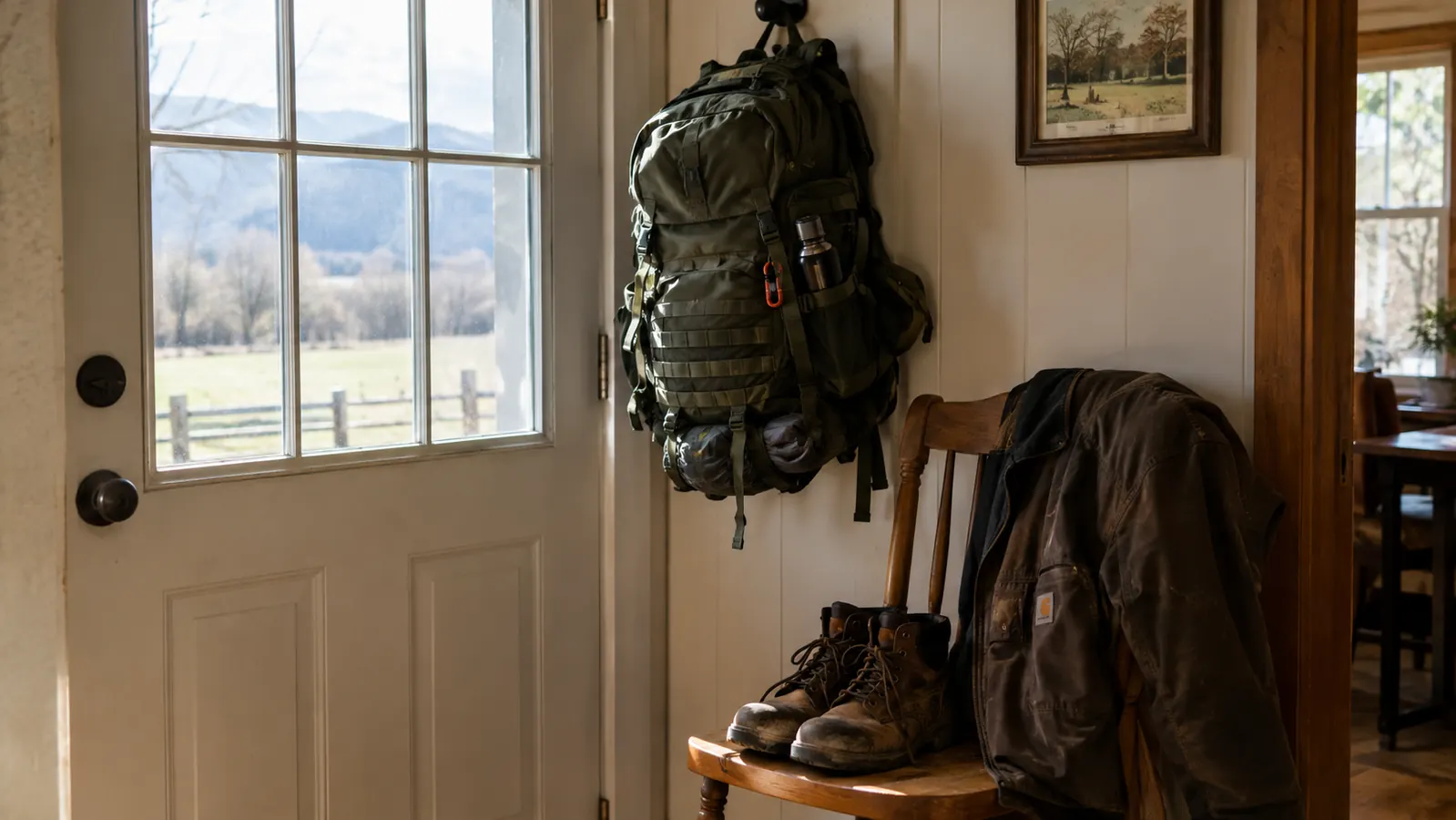
Keep the bag somewhere you can reach it in the dark. Ours hangs on a hook right inside the back door, and there is a pair of old boots and a Carhartt jacket on the chair next to it. We have a go-bag drill twice a year: I time how long it takes us to grab the bags, put on shoes, and get to the truck. The first time we did it, it took over four minutes. Last time, it took under two. Practice turns panic into routine.
Step 5: Test It for Real, Then Fix What Fails
You cannot know a go bag works until you live out of it for a night. In March, I took the Ready America kit on an overnight in the Smoky Mountain foothills, the kind of short trip I do a few times a year to test gear. I hiked about three miles in, set up a small tarp, and spent the night with only what was in the bag. It was 38 degrees that night, and I learned more in those fourteen hours than in all the reading I had done about emergency kits.
Three things failed the test. The food bars were hard to choke down cold, which is why I added the peanut butter and granola bars. The hand-crank radio worked fine, but charging a phone with it took longer than I expected, so I added a small power bank that I recharge twice a year. And the emergency blanket that came with the kit is thin. It reflects heat, but I would not want to sleep under it. I added a proper wool blanket, the kind that weighs about three pounds, and it made the bag genuinely warmer.
Nothing about that night was dramatic. That is the point. An emergency kit is not tested by how it performs in a movie. It is tested by whether you can sleep, eat, and stay dry when things go sideways. One night in the woods told me more than a year of reading reviews. If you cannot get out overnight, do the kitchen drill instead: live out of the bag for 24 hours at home, and write down everything you reach for that is not in the bag.
What Else Helps
A few things did not fit neatly into the steps above, so here they are. Keep a printed map of your county in the bag. Phones lose service, and paper does not. Add a small flashlight with extra batteries, even though the kit has a crank light, because two lights are better than one. A roll of duct tape, a multi-tool, and a box of matches in a waterproof container have bailed me out of more small problems than I can count. And keep a smaller get-home bag in the Tacoma year round, because the bag by the back door only helps if you are home when things happen.
Also, tell people about it. Carol and I have a simple plan: if something happens and we are apart, we meet at the house if we can, and if we cannot, we head to a meeting point forty miles north that we picked out together. We wrote that plan on a card and put it in each bag. A go bag is not just gear. It is a conversation you have with your family about what you would do, before you need to do it.
One night in the foothills at 38 degrees taught me more than a year of reading about emergency kits. Three things failed the test, and I fixed all three before I needed them.
Build Yours on the Same Foundation I Used
The Ready America 70280 is the backbone of the bag by my back door. It is not the finished answer, nothing is, but it is a solid start that leaves room for everything your family needs.
Amazon Check Today's Price on Amazon →