
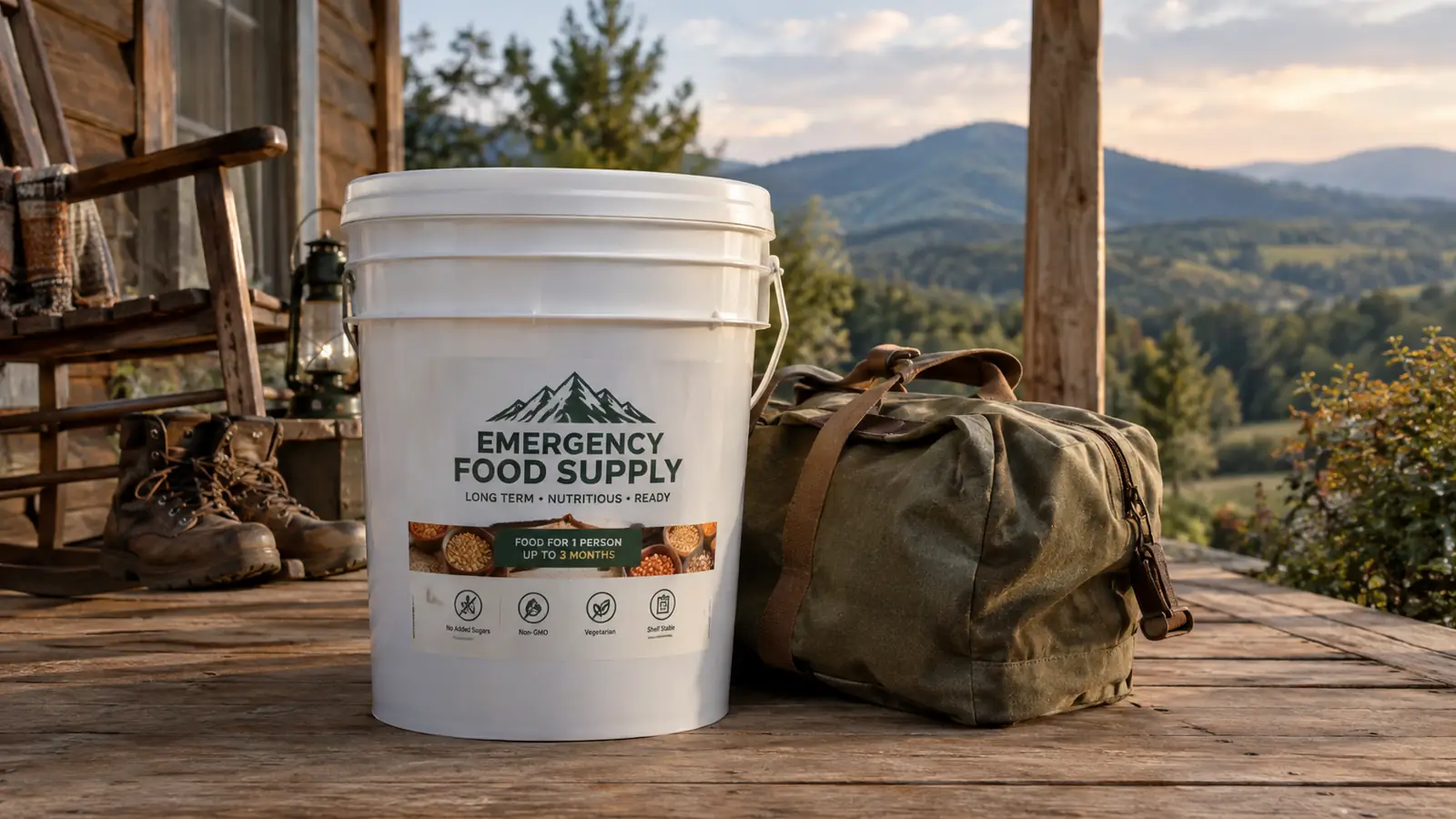
I spent 30 years restoring power after storms, and I can tell you exactly how long people go without groceries when the lights go out. Longer than they expect. When I finally sat down to build a real food supply for my house outside Knoxville, the ReadyWise 120 serving bucket was on every list I found. So I bought one, and then I did what I do with all my gear: I actually used it. For seven straight days, my wife Carol and I ate ReadyWise breakfast, lunch, and dinner. This is the honest review, the stuff the product page does not tell you.
The short version: ReadyWise is a solid, affordable way to put a month of calories on a shelf, and the food is better than you are expecting. But it is also salty, repetitive, and light on true nutrition. Whether it is worth your money depends on what you are preparing for. Let me walk you through what I learned.
The Quick Verdict
A dependable, budget-friendly calorie reserve that tastes better than survival food has any right to. Just plan for the sodium and the repetition.
Amazon Check Today's Price →A month of calories on your shelf for less than a dinner out
The ReadyWise 120 serving bucket is the easiest way I have found to stop worrying about the grocery store during a long outage. Check today's price on Amazon and see if it fits your kit.
Amazon Check Today's Price on Amazon →How I Tested It
I did not just open the bucket and sniff the pouches. I committed to a full week of ReadyWise for two adults. That is 42 meals, which is more than a third of the bucket. Carol was not thrilled, but she agreed on one condition: I had to cook it exactly like the instructions said, no doctoring it up with fresh ingredients to make it taste better. Fair enough. If I was going to review the product, I was going to review the product.
I kept a notebook on the kitchen counter. Every meal got a score for taste, a note on texture, and a rough count of how long it took to prepare. I also tracked how I felt after each meal, because a food supply that leaves you sluggish is a food supply that fails you when you need energy the most.
The bucket itself is straightforward. You pop the lid, and inside you find a stack of pouches, each one labeled with a meal and a serving count. No measuring cups required, no complicated math. The instructions on each pouch are simple: add water, stir, wait, eat. For a guy who has cooked over a camp stove in the dark more times than he can count, that simplicity is a feature, not a flaw.
The first morning set the tone. I picked the apple cinnamon oatmeal, added the water line to the pouch, and waited the full eight minutes. It came out thicker than I expected, with actual apple bits in it. Carol ate hers without a single complaint, which for her is high praise. That first breakfast took me about ten minutes from opening the pouch to sitting down, and most of that was waiting. I made one mistake early on that I want you to avoid: I used lukewarm water from the tap the second morning, and the oatmeal came out lumpy and took twice as long to soften. Hot water is worth the extra minute of stove time. By the end of the week I could have a full meal ready in the dark without turning on a light, which is exactly the skill you want before an outage, not during one. I have been through a nine day ice storm without power, and I can tell you the people who fared best were the ones who could cook without thinking about it.
What Nobody Tells You About the Taste
Here is the honest truth: ReadyWise tastes better than it has any right to. I went in expecting bland, chalky survival fare, the kind of thing you eat because you have to. Instead, the pasta dishes were genuinely decent. The creamy pasta and vegetables had a real flavor to it, the kind of thing you would not be embarrassed to serve on a camping trip. The rice dishes were a little plainer, but a splash of hot sauce fixed that in a hurry.
But there is a catch, and it is the thing nobody puts on the product page: the meals start to taste the same. By day three, Carol and I were both noticing that every pouch had the same underlying flavor profile. It is hard to describe, but it is there. A little salty, a little savory, a little processed. You will not starve, and you will not gag, but you will start dreaming about a fresh salad around the middle of the week.
The texture is the part I did not expect. Everything comes out softer than the same dish made from scratch, because the freeze dried ingredients rehydrate into a uniform, tender consistency. That is not a bad thing when you are eating by headlamp, but it does mean the meals blur together faster. The only real standout in the other direction was the cheesy broccoli rice, which had enough going on that I actually looked forward to it on day five. The rest of the pouches were fine, and fine is the word I would use in the notes: not great, not bad, just fine.
By day three, Carol and I were both noticing that every pouch had the same underlying flavor profile. You will not starve, and you will not gag, but you will start dreaming about a fresh salad.
The Sodium Problem Nobody Mentions
Here is the number that matters most, and it is the one the marketing materials dance around: sodium. A single serving of many ReadyWise meals contains 600 to 800 milligrams of sodium. The American Heart Association recommends keeping it under 2,300 milligrams a day, and ideally closer to 1,500. If you eat three ReadyWise meals a day, you are blowing past that number before you finish dinner.
For a healthy adult, that is a manageable tradeoff during a short emergency. Your body will handle a few salty days. But if you have high blood pressure, heart issues, or kidney problems, this bucket is not a great fit. That is not a knock on ReadyWise, it is just a fact you need to know before you buy. I wrote the sodium numbers in my notebook as I went, and the range surprised me. The creamy pasta dishes ran the highest, close to 800 milligrams, while the oatmeal and the fruit options stayed under 500. My first attempt at managing it was to split the pouches and eat half portions more often, but that only stretched the meals thinner and left me hungry. Drinking extra water helped more than anything else, so I added a second quart of water to my daily routine and the headaches I got on day two did not come back.
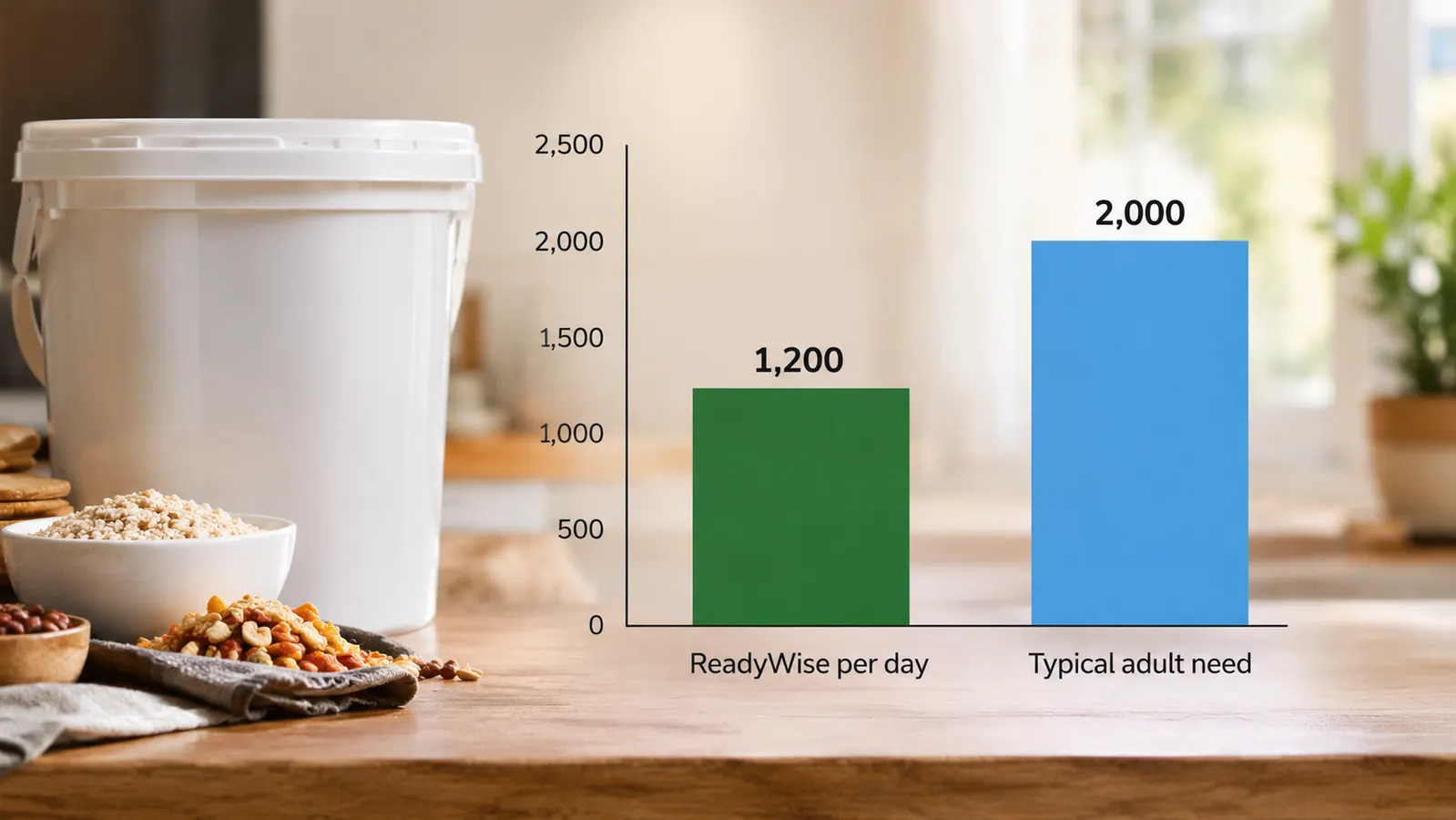
The other thing nobody tells you: the calories are lower than you think. The bucket is marketed as 120 servings, which sounds like a lot. But a serving is often just 200 to 250 calories. Do the math and the whole bucket works out to roughly 1,200 to 1,400 calories per day for one person for about 30 days. That is enough to keep you alive, but it is not enough to keep you fueled if you are doing physical work, like chopping wood or hauling water.
I felt it myself on day four. I spent the morning splitting firewood, the kind of work I did for a living for three decades, and by noon I was dragging in a way that had nothing to do with age. I had eaten a full ReadyWise breakfast and a full ReadyWise lunch, roughly 500 calories total, and my body was telling me it wanted more. That afternoon I added a peanut butter sandwich to my lunch and the difference was immediate. The lesson stuck with me: treat the bucket as the base of your calories, not the whole story, and you will be a lot more comfortable when the power is out.
What the 120 Servings Actually Mean
Let me break down the math the way I wish someone had for me. The bucket says 120 servings. That sounds like a two month supply for one person, or a one month supply for a family of four. The reality is more modest. At 1,200 to 1,400 calories per day, the bucket is really a 30 day supply for one adult, or a 15 day supply for two. For a family of four, you are looking at about a week of calories, not a month.
That is not a dealbreaker, it is just a reality check. The bucket is priced to be an entry point, a way to get a solid foundation of calories on the shelf without emptying your wallet. If you need a true 30 day supply for a family, you will need to buy several buckets, or mix in other foods like rice, beans, and canned goods to stretch it further.
The good news is that ReadyWise makes it easy to build on. The pouches are compact, the bucket stacks well, and the 25 year shelf life means you can buy one now and forget about it for a decade. That is the real value proposition: peace of mind, stored in a bucket, that you do not have to think about again until you need it.
I weighed the bucket on the bathroom scale when it arrived and again after the week was over. It came in at 20 pounds, 3 ounces full, and after 42 meals it was down to 13 pounds, 11 ounces. That tells you two things. First, the food is dense, which is what you want when you are storing it in a closet or the back of my Tacoma. Second, a full bucket is light enough for Carol to move on her own, which matters if I am not home when something happens. I would not want to carry it five miles, but I would not need to. It lives in the house, not on my back. I also measured the footprint before I put it away: about a foot and a half square and two feet tall, which fit on the top shelf of my pantry closet next to the canned goods. That matters more than people think, because the best food supply is the one that is actually in your house, not the one you meant to buy. The pouches stack flat when empty, so if you ever need to move the supply into a go bag, the food compresses into about half the space.
How It Performed in a Real Outage
A week of eating ReadyWise in my kitchen is one thing. A week of eating it when the power is out is another. I have been through enough ice storms to know that the second scenario is the one that matters. So I took the bucket on my last overnight in the Smoky Mountain foothills and cooked it over a camp stove, the way I would in a real emergency.
The verdict: it works. The pouches are lightweight and pack flat, which means they fit easily into a backpack or a go bag. The preparation is simple enough to do by headlamp. I cooked the creamy pasta and vegetables that night, and it came together in about twelve minutes over a two burner camp stove, even with my hands cold. The taste, which I had already judged in my kitchen, held up fine when I was cold, tired, and hungry. That is the real test, and ReadyWise passed it. One thing I noticed on the trail: the meal smelled stronger than I expected when it was cooking, which is a detail worth knowing if you are trying to stay discreet. Out in the open it did not matter. In a crowded shelter it might.
One thing I will note: the pouches are not resealable. If you do not eat a full pouch in one sitting, you need to fold the top over and clip it, or transfer the leftovers to a container. In a real emergency, that is a minor annoyance, but it is worth knowing. A few resealable pouches would make this bucket significantly better.
The other thing I learned on that overnight: water matters more than the food. Every pouch needs about two cups of water, and a day of ReadyWise meals means roughly six cups just for cooking. I measured it that night: a full day of breakfast, lunch, and dinner took seven cups, including the extra cup I used to rinse the pot. That is on top of what you drink. I carry a filter in my Tacoma, so it was not a problem for me, but if your plan is a case of bottled water in the garage, you need to double it. The bucket does not come with water, and the instructions assume you have it. Plan for that before you need it.
The Pros and Cons, Plain
What I Liked
- Tastes better than survival food has any right to, especially the pasta dishes
- Simple to prepare with just water, even by headlamp in the dark
- 25 year shelf life means you can store it and forget it
- Compact, stackable bucket that is easy to move and store
- A realistic entry point for building a food supply on a normal budget
Where It Falls Short
- High sodium, roughly 600 to 800 milligrams per serving, too much for some people
- Only about 1,200 to 1,400 calories per day, not enough for hard physical work
- Meals start to taste the same by day three
- Pouches are not resealable, so leftovers need a clip or a container
- The 120 servings math is optimistic for a family, plan for a week, not a month
Who This Is For
ReadyWise is for the person who wants a realistic, budget friendly food supply without overthinking it. It is for the family that wants a month of calories in the basement, the camper who wants a lightweight backup for the trail, and the person who is just starting their preparedness journey and needs a solid foundation. If you are looking for a way to stop worrying about the grocery store during a long outage, this bucket is a great place to start.
Who Should Skip It
If you are on a low sodium diet, have high blood pressure, or need a food supply that is genuinely nutritious rather than just caloric, look elsewhere. If you need a true 30 day supply for a family of four, you will need to buy multiple buckets, and there are better values for that. And if you are a picky eater, the repetition will wear on you fast. ReadyWise is a tool, not a gourmet meal. It is a good tool, but it is not for everyone.
Stop guessing and get a month of calories on the shelf
The ReadyWise 120 serving bucket is the most straightforward way I have found to build a food supply without breaking the bank. Check today's price on Amazon and see if it is the right fit for your family.
Amazon Check Today's Price on Amazon →