
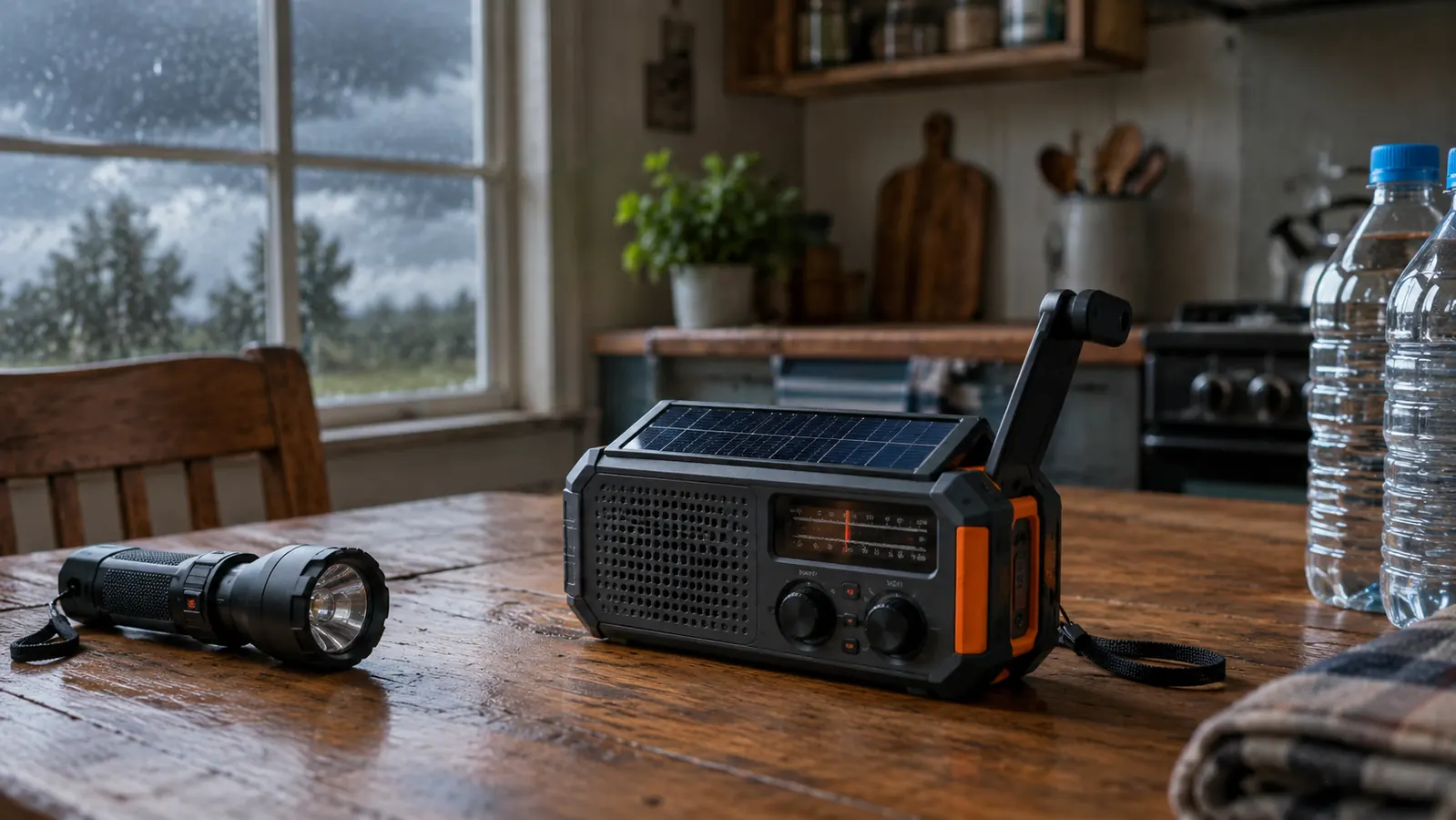
I spent thirty years restoring power after storms, and the thing people never believe is how fast the phones stop being useful. The cell towers run on generators for a while, and then they don't. The weather app that told you the storm was coming becomes a dead icon on a dead screen. The texts from your family stop arriving. That is the moment a radio you can crank by hand stops feeling like a gadget and starts feeling like the most sensible thing you ever bought. This is my long-term review of the FosPower NOAA Emergency Weather Radio A1, after living with it through a full Tennessee storm season.
I'm Wade Callister, a retired electrical lineman from outside Knoxville. I spent three decades watching what outages do to people, and an ice storm once left my own house dark for nine days. So I don't review emergency gear from a desk. I carry it, I crank it, I charge phones from it, and I sleep next to it when the weather turns. The FosPower A1 replaced a battery-eating unit I'd carried in my Tacoma for years, and it has earned a permanent spot in the 72-hour kit by my back door.
The Quick Verdict
A sturdy, no-excuses weather radio with a crank that actually works and NOAA reception that pulls in alerts from a hundred miles out. It has outlasted every battery-powered radio I've owned. The solar panel is a trickle, not a charger, and the flashlight is fine rather than great, but the core job, keeping you informed when the grid goes down, it does without drama.
Amazon Check Today's Price →The radio that keeps working when the phone doesn't
The FosPower A1 has a 7,400 mWh battery, NOAA alert reception, and a hand crank you can use one-handed. After a year of storm season and a couple of real outages, mine has never let me down.
Amazon Check Today's Price on Amazon →How I've Used It
For the past year, the FosPower A1 has lived in rotation between the kitchen counter and the 72-hour kit by the back door. During spring storm season in East Tennessee, it sat on the counter with the antenna up, tuned to the Knoxville NOAA station. I checked it the way other people check their phones, a quick glance at the forecast that mattered, the one that comes from a transmitter you don't need a data plan to reach.
I tested it the way I test everything, by using it for the job. Every week I did a full crank test. Once a month I ran the battery down and charged it back up from the wall to keep the cells healthy. I carried it in the Tacoma on overnight trips into the Smoky Mountain foothills, where the FM reception is spotty and the NOAA signal is what actually comes through. And twice during the year, the power went out at my house, once for two days in May and once for a night in August when a line came down on our road.
The two-day outage in May is the test that matters. I used the radio for the evening news on FM, charged my phone from its USB port, and left it in a south window during the day to see what the solar panel would do. When the power came back, the radio still had enough charge to run for hours, and my phone had gone from 18 percent to a full battery. That is the whole job, right there.
What the FosPower A1 Actually Is
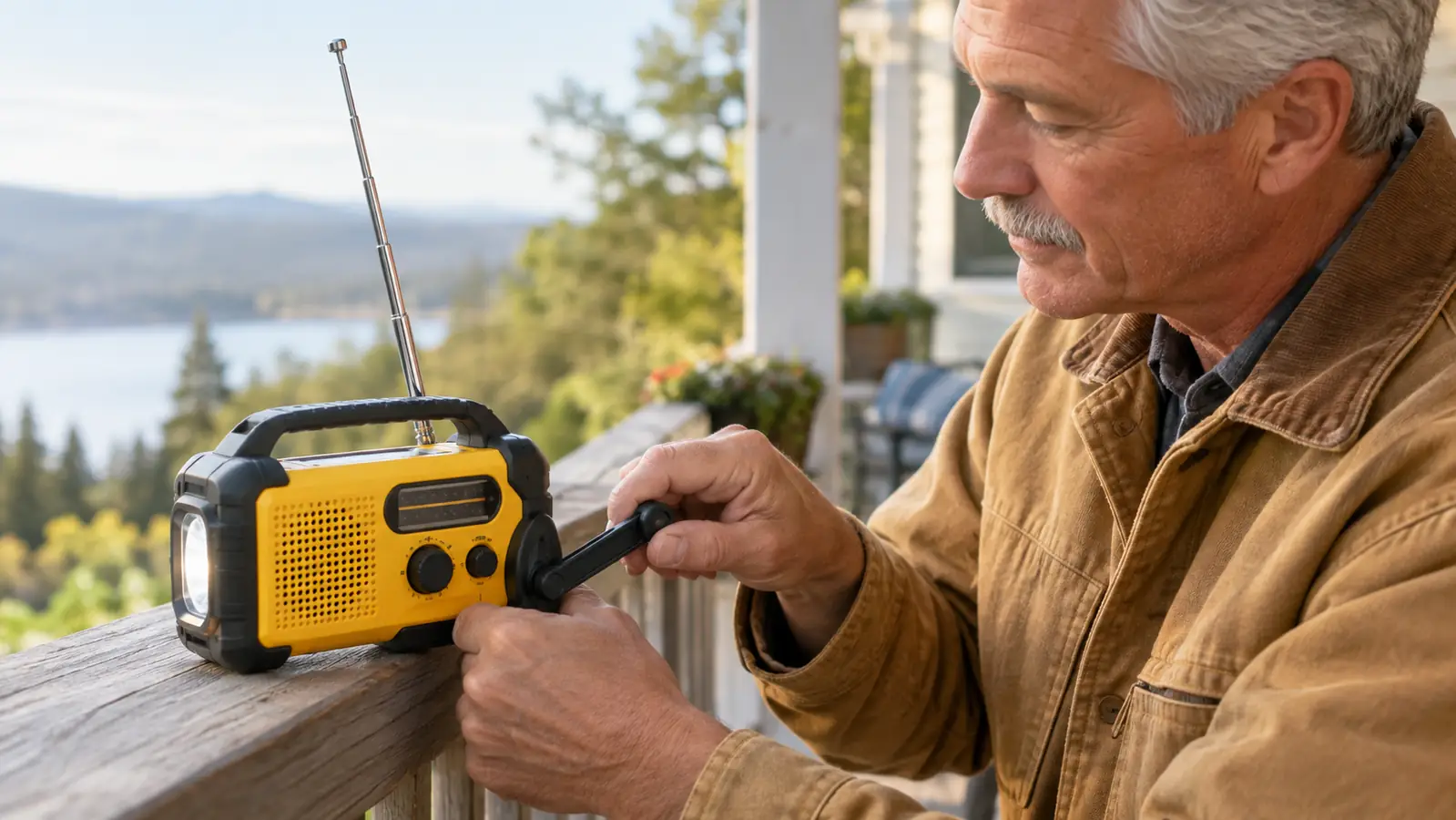
The A1 is a full AM/FM radio with a NOAA weather band on top, a 7,400 mWh rechargeable battery, a hand crank, a solar panel across the front, and a USB port that turns it into a power bank for your phone. It has a flashlight on the back, a small reading lamp on the side, and an SOS siren for signaling. It is not a toy, and it is not a piece of tacticool gear. It is a working radio built for people who want their information to survive the storm.
The NOAA weather band is the reason to buy any weather radio, and it is the reason to buy this one. It receives all seven NOAA channels, which in my area means I can pull the Knoxville transmitter clearly and, with the antenna fully extended, stations from further out when conditions are right. The alert function works too. When the National Weather Service issues a warning, the radio can sound an alert tone, and it is loud enough to hear from the other end of the house.
The build quality surprised me for the money. The casing is thick plastic with a rubberized grip, the crank folds flat, and the antenna is a proper telescoping rod rather than a wire you have to fuss with. Nothing on mine has loosened, cracked, or worn out after a year of weekly cranking and a few drops onto the kitchen floor. For a piece of gear that sits in a bag for months at a time, that durability matters more than any feature list.
The Hand Crank and Solar Panel Under Real Use
The hand crank is the part most weather radios get wrong. Either it feels like it is going to snap, or it takes twenty minutes of turning to produce ten minutes of radio. The FosPower crank is the middle ground done right. It ratchets, so you can pump it in short strokes instead of full circles, and three minutes of cranking gives you roughly ten to fifteen minutes of radio, or enough to top up your phone a few percent. That sounds modest until you remember the alternative, which is nothing.
Here is the honest part about the solar panel: it is a trickle, not a charger. In full, direct summer sun, a day on the windowsill might add a meaningful amount of charge to the internal battery. In winter, or under cloud cover, it will barely keep pace with the clock. I treat the solar panel as a slow top-up that extends the battery between outages, not as the main way to charge the radio. The crank is the real charger, and the wall outlet is the fastest one. Anyone who expects to set this in the sun for an hour and get a full battery is going to be disappointed.
The battery itself, the 7,400 mWh cell, holds a charge for months. I tested that by charging the radio fully, letting it sit for two months, and finding it still had most of its charge when I picked it up. That matters because a weather radio that lives in a kit needs to be ready when you grab it, not when you remember to charge it.
Reception, Sound, and the NOAA Alerts
Reception is where cheap radios fall apart, and it is where the FosPower holds up. With the antenna extended, the NOAA station comes in clear in my kitchen, in the garage, and in the foothills where FM drops out entirely. The AM band is less impressive, which is normal for a portable unit, but the FM and NOAA bands are what I actually use.
The speaker is clear at moderate volume and gets genuinely loud, which matters when the alert tone goes off at two in the morning. There is a headphone jack too, so I can listen to the news without waking Carol when we are both waiting out a storm. The digital display shows the station frequency and a battery indicator, and while the tuning dial is a little small, I found the station lock reliable once I got used to it.
I tested the alert function on purpose, not by accident. The NOAA test tone came through loud and unmistakable, and the radio stayed on the weather band after the alert ended so I could hear the actual warning. That is the behavior you want. Some radios bounce back to whatever you were listening to and you miss the details. This one keeps you on the information you need.
Power Outages and the Long Haul
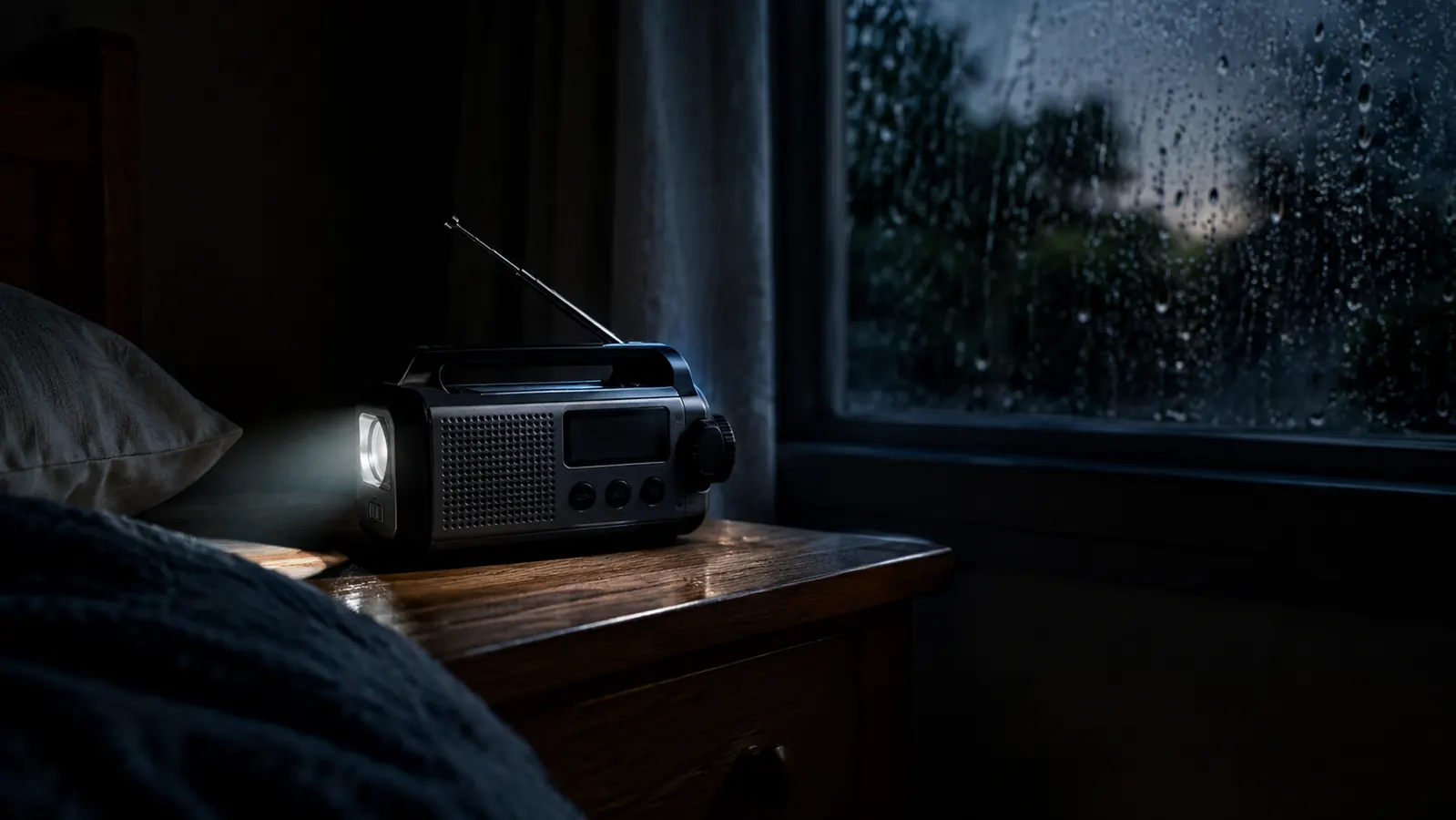
The May outage is the one that convinced me. The line came down at 9:40 on a Sunday night, and the power did not come back until Tuesday afternoon. We used the FosPower for the news, for the high school baseball scores Carol wanted, and for charging both our phones. The radio ran for hours each evening, took a few minutes of cranking while we watched the news, and sat in the window during the day. It never once made me wonder whether it would start. That is the entire point of emergency gear.
The nine-day ice storm from a few years back taught me what a long outage does to a household. The first two days are about information, and after that they are about routine. A radio like this one is what keeps the routine from falling apart. You get your news at the same time, you know what the roads are doing, you know whether the school bus is running. The phone is for the people you love. The radio is for the world.
I also keep a spare set of the basics in the Tacoma's get-home bag, and the FosPower has ridden along on every overnight trip to the Smoky Mountain foothills this year. It takes a beating on forest service roads, it does not mind being tossed into a duffel, and it has never failed to pick up the NOAA forecast when I needed to decide whether to move camp. For my money, that is what a preparedness tool should do, sit quiet, take abuse, and deliver when asked.
What I'd Change
No piece of gear is perfect, and the FosPower A1 has three honest weaknesses. The solar panel is the one I hear people complain about most, and they are right to. It needs hours of direct sun to meaningfully charge the battery. Treat it as a top-up and you will be happy. Treat it as the main charger and you will be frustrated.
The flashlight is fine for reading a map or walking to the breaker box, but it is not a serious light. If the power is out for days, you want a dedicated flashlight in your kit anyway. The tuning dial is also small, and in the dark, with cold hands, it takes a moment to hit the station you want. None of these are dealbreakers. They are just reasons to know what you are buying.
One more note: the radio is splash resistant but not waterproof. It lives in the house and in the truck, not in the creek. If you want something to leave outside in the weather, this is not it. For everyone else, these are small tradeoffs for a radio that costs a reasonable amount and does the one job that matters.
What I Liked
- Hand crank that genuinely works and never feels like it will snap
- NOAA reception is strong, with alerts loud enough to hear across the house
- 7400 mWh battery holds a charge for months, so it is ready when you grab it
- USB port charges a phone in a real outage
- Sturdy build that has survived a year of weekly crank tests and a few drops
- Headphone jack and reading lamp are small touches that earn their place
Where It Falls Short
- Solar panel is a slow trickle, not a practical charger
- Flashlight is adequate, not bright
- Tuning dial is small and fiddly in the dark
- Not waterproof, so it stays inside during the storm
When the power came back after two days, the radio still had charge to spare and my phone, charged off its USB port, was full.
Who This Is For
This radio is for anyone who lives where the weather can take the power out for more than a night. It is for the people in rural counties where the cell tower is on the next ridge, for the families who remember the ice storm of a few years back, and for the folks who want a 72-hour kit that does not depend on batteries they forgot to buy. It is for the person who wants peace of mind, not a wall of tacticool gear. If that is you, this is a sensible, affordable place to start, and it will still be working when you need it.
Who Should Skip It
Skip it if you expect the solar panel to charge like a wall outlet, because it will not. Skip it if you want a weather radio with SAME technology that only alerts for your specific county, because this one alerts for the whole region. Skip it if you need a waterproof radio to leave outside, or if you want Bluetooth and phone-app integration, because this is deliberately simple. And if you already have a solid NOAA radio that you actually use, you do not need this one. The goal is to be prepared, not to own gear.
Put one in the kit before the next storm, not after
The FosPower A1 has been through a full storm season, two real outages, and a year of weekly crank tests at my house. It has not let me down. When the power goes, you will not be scrolling for a charger, you will be turning a crank and listening to the forecast.
Amazon Check Today's Price on Amazon →